Cathy and I didn't set out to start a health company. Health Detectors grew out of personal experience — and a growing awareness that the kind of thorough, coordinated, evidence-based health assessment we were looking for simply didn't exist as a ready-made program. Not in the US, and not quite in Germany either. So we built one.
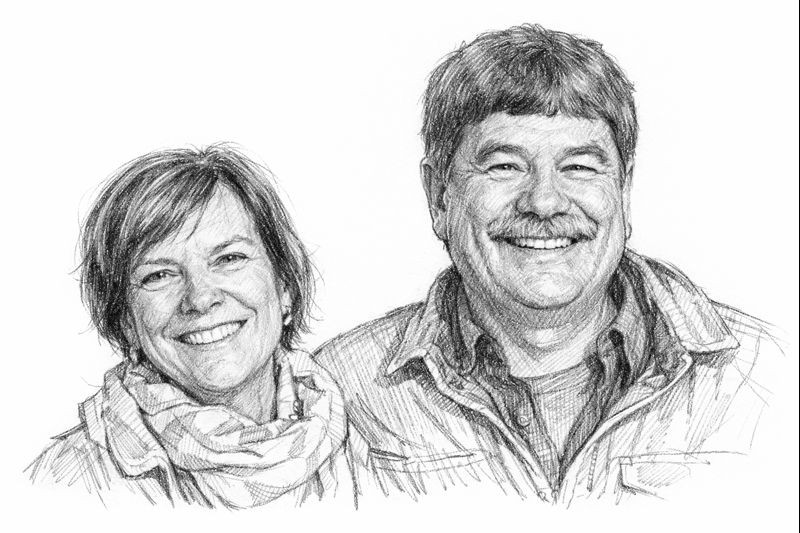
Here's the short version: over the years, Cathy and I became increasingly aware of how challenging it had become to access the kind of medical care we were looking for. Even with good insurance, timely appointments were hard to get. Costs were unpredictable. And the annual physical — the system's main tool for keeping healthy people healthy — always left us feeling like something was missing.
We didn't know what the alternative looked like until we experienced it ourselves — in Munich.
What we found in Germany
Over several years, Cathy and I managed our own medical care in Munich. It wasn't planned that way — it started with a single appointment and grew from there. But during that time, we encountered a healthcare system that felt fundamentally different from what we were used to.
What stood out first was the access. When you need to see a specialist in Munich, you see one — usually within days, not months. There's no referral chain, no pre-authorization, no weeks of phone calls with insurance. You call, you make an appointment, you go.
The second thing was the coordination. Physicians talked to each other. Test results moved between offices without us carrying a folder. The cardiologist knew what the endocrinologist had found. It sounds basic — and it should be — but after years of being our own medical coordinators back home, it felt like a revelation.
The third thing was the cost transparency. At comparable levels of care — sometimes better equipment, often more specialist time — treatment and prescription costs were significantly lower than what we were accustomed to. No surprise bills. No mysterious charges arriving months later. The price was the price.
And throughout all of it, as American patients, we consistently experienced professional care and clear communication. English is widely spoken throughout the German medical system, especially in Munich. We never felt lost.
We weren't looking for a luxury experience or a wellness retreat. We were looking for someone to actually, seriously, carefully look at our health. And then tell us the truth about what they found. In Munich, that's exactly what we got.
From patients to founders
The more time we spent navigating healthcare in Munich, the more we realized something: this system is excellent, but it's not easy for outsiders to access. Understanding the structures, the processes, the administrative requirements — knowing how the German system works, which specialists to see, how to get records transferred, what the insurance situation looks like — that's hard without guidance. We had years of trial and error. Most Americans visiting Germany don't have that.
At the same time, we kept noticing that even the existing German executive check-up programs had gaps. Some were great at the clinical side but wrapped it in a cold, institutional package. Others were warm and friendly but light on evidence — offering trendy tests that sounded impressive but had no proven benefit. We wanted both: clinical rigor and a program that actually felt like someone gave a damn about the patient experience.
That's when the idea took shape: what if we could bridge the gap? Take everything we'd learned as American patients in Munich — the access, the quality, the coordination, the cost transparency — and build a structured program around it, designed specifically for people like us?
So we built it ourselves
The turning point came through a close friend of ours — a surgeon at one of Munich's university hospitals. He'd spent decades in academic medicine, transplant surgery, clinical research. We'd known him for years and had always talked about the gap between what preventive medicine could be and what it actually was. When we told him what we wanted to build, he didn't just encourage us — he rolled up his sleeves and helped us design it.
Together with him and a network of board-certified specialists he trusted, we built a program that was genuinely evidence-based. Not evidence-based as a marketing term. Actually evidence-based: every test on the panel has published data showing it changes outcomes. If a test doesn't meet that bar, it's not in the program. End of discussion. That rigor came from him — from someone who reads the Cochrane reviews, who knows the difference between a well-designed trial and a marketing study, and who wouldn't let us cut corners.
We spent months on the design. Which biomarkers belong in the core panel and why. Which specialist modules should be available and for whom. How to structure the five days so patients aren't exhausted by Day 3. How to write a risk report that's detailed enough for a physician but understandable for a patient. How to handle findings that are serious.
And then — and this was non-negotiable for both of us — Cathy and I went through the entire program ourselves.
Why we did it ourselves first
Call it a principle, call it stubbornness. But we refused to offer something to other people that we hadn't experienced ourselves. Every blood draw, every specialist consultation, every fitness test, the full risk report, the closing session — we did all of it. Not a shortened version. The real thing.
We both had findings. Nothing dramatic — we're both in reasonable shape — but things that wouldn't have shown up on any standard US check-up. Things we could actually do something about. That was the moment we looked at each other and said: okay, this is real. This actually works.
Testing the hotels, too
Here's something people don't expect from a health company: we also personally check out the hotels we recommend to patients.
It sounds like a small thing, but think about it from the patient's perspective. You're flying from the US to Munich for a medical program. You're a little anxious. You've never been to Germany, or maybe you have but you don't know Munich well. The last thing you want is to arrive at a hotel that looked great on the website but turns out to be noisy, badly located, or staffed by people who don't speak English.
So Cathy and I stay at the hotels ourselves. We check the rooms, the location relative to the specialists you'll be visiting, the breakfast situation (you'll need to fast on Day 1 — does the hotel accommodate that?), the neighborhood for your free day. We walk the routes. We eat at the restaurants nearby. We make sure that when we recommend a place, it's because we'd stay there ourselves.
It's the same principle as going through the medical program: we don't recommend what we haven't tried.
What Health Detectors actually is
Health Detectors is a five-day evidence-based preventive health program in Munich. You fly in, you go through a comprehensive risk assessment with board-certified specialists in private practice, you get an integrated risk report, and you go home with a clear plan for what to do about what was found.
It is not a luxury wellness retreat. There's no spa. There's no juice cleanse. There's no supplement store in the lobby.
It is not a longevity clinic. We don't promise to make you live to 120. We don't offer tests that sound futuristic but have no published evidence behind them.
It is, as closely as we could make it, the program Cathy and I spent years looking for. The one that takes your health seriously enough to actually look — carefully, thoroughly, with the best tools available — and then has the honesty to tell you exactly what it found.
We're proud of it. And we're proud that we can say, without any asterisk: we've done this ourselves, and we'd do it again.